
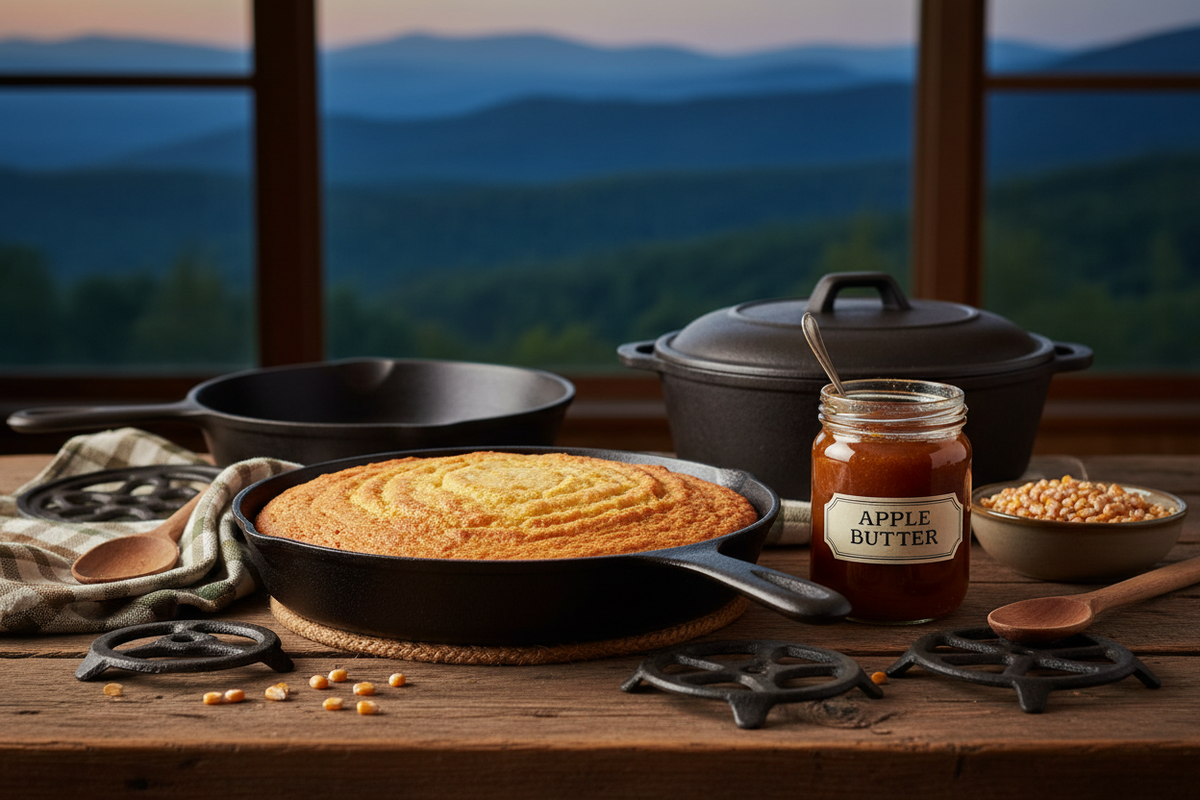
In the mountains of Southwest Virginia, food was never just about eating. It was about preparation, preservation, and gathering. Recipes were shaped by the land, the seasons, and the tools available, then passed down until they became tradition.
Mountain kitchens told stories just as clearly as music or landmarks, through the smell of apples cooking down, the sound of cornbread sizzling in cast iron, and the quiet rhythm of hands at work.
📜 Food as Survival and Memory
Early Appalachian families depended on what they could grow, gather, or trade. Store bought goods were rare, so meals were built around staples like cornmeal, apples, beans, and preserved meats.
Cooking was practical, but it was also personal. Recipes were rarely written down. They were learned by watching, tasting, and repeating. A pinch of this. A little more time on the fire. Food carried memory as much as nourishment.
🍏 Apple Butter as a Community Effort
Apple butter was not made alone. It was a group effort that brought neighbors together, often in the fall when apples were plentiful. Large kettles were set over open fires, and the mixture was stirred for hours to prevent burning.
Apple butter making meant:
-
Long conversations
-
Shared labor
-
Stories told while stirring
-
Children learning by watching
The process mattered as much as the result. In many communities, apple butter days became annual traditions that marked the changing seasons.
🍞 Cornbread at Every Table
Cornbread was a daily staple across Appalachia. Made from ground corn grown nearby and milled locally, it filled bellies and stretched meals.
Cooked in cast iron skillets, cornbread developed a crisp edge and hearty texture. It was eaten with beans, greens, milk, or whatever was available. Simple, filling, and dependable.
In places like Scott County, cornbread was less a recipe and more a constant.
🔥 Cast Iron as a Kitchen Essential
Cast iron cookware was prized because it lasted. One skillet could serve generations, moving from hearth to wood stove to modern kitchen.
Cast iron:
-
Held heat evenly
-
Could be used over open flame
-
Was easy to repair and reseason
-
Became better with use
These pans were not replaced. They were cared for, much like the traditions they supported.
🏡 Kitchens as Gathering Places
Mountain kitchens were warm, busy spaces. They were where people gathered at the start and end of each day. Food brought families together, offered comfort during hardship, and celebrated milestones both big and small.
Meals were shared without fuss. Hospitality mattered. No one left hungry if there was food to give.
🌲 A Blue Ridge Whispers Reflection
At Blue Ridge Whispers, we see mountain food traditions as a reminder that the simplest things often carry the most meaning. Time, care, and shared effort turn basic ingredients into something lasting.
Our candles and wax melts are inspired by those same kitchens, places filled with warmth, memory, and the comfort of something familiar.
Leave a comment